Posts

Should Educators Use AI Detection Tools?
Image
Last week, I read the same answer to an essay question from three students in a row. Well, not exactly the same answer, but darn close. The three answers contained the same language, number of sentences, and general idea. I'm guessing that happened because students used generative artificial intelligence to write these short answers. I added essay questions to all my quizzes to ensure students demonstrated their understanding of the material  in their own words . I realize those essay questions no longer achieve my goal, so it's time to rethink. One option when suspecting that students are using AI to create their work is to use an AI detector tool like Turnitin's AI Content Detector (which currently comes with a subscription to Turnitin) or GPTZero, which was developed to sniff out the use of ChatGPT. This blog post explores whether these detection tools actually solve the problem.  A little recent history in our own backyard is helpful. Last year, Maricopa County Communi...

Nurturing Critical Thinkers

Image
It's springtime! 💐 The trees are growing leaves and blossoming flowers. Nurturing trees with mulch, fertilizer, and extra water helps them grow. The same is true for people. We need nutrients and water to grow, but additionally, we need stimulation to keep our minds growing and flourishing. Being expected to think critically stimulates our minds and creates growth, and the ability to think critically is indispensable in our information-rich world. Critical thinking is widely recognized as a cornerstone of higher education, empowering students to analyze, evaluate, and synthesize information effectively. As educators, fostering critical thinking skills among students is a fundamental responsibility. This blog post explores effective strategies for teaching critical thinking in higher education classes. One seminal study by Paul and Elder (2008) underscores the importance of explicit instruction in critical thinking. The authors advocate for a structured approach that teaches stude...

Leprechauns and Assessments

Image
As Saint Patrick’s Day approaches, I thought discussing the fairy tale of leprechauns and the value of real-life authentic assessments would be fun. Let’s start with leprechauns. Did you know these magical little people "existed" before St. Patrick's Day even came to be? Leprechauns were initially written about in 19th-century Irish fables where they are described as short men who just happened to be exceptional shoemakers. After making money, they were said to hide their coins in pots of gold at the end of rainbows. I can’t help but smile. Just an aside, although leprechauns have been spoken of in literature since the 1800s, they’ve only been associated with St. Patrick's Day since 1959, when Disney released a film called Darby O'Gill and the Little People . While leprechauns dwell in the fairy world, authentic assessments keep our students grounded in reality. These assessments involve applying knowledge and skills in real-world situations, scenarios, or problem...

How Do You Like Your Chocolate?

Image
With Valentine’s Day right around the corner, it’s hard not to think about love and chocolate–or, in my case, the love of chocolate. Those heart-shaped boxes with chocolate delicacies keep popping into my mind. I prefer the ones with the chocolate cream filling or nuts. By far, though, my favorite kind of chocolate is plain, rich, dark chocolate. Do you like your chocolate sweet and creamy, bold with a little bite, nutty and salty, or in the form of a Sprinkles cupcake? We all have our favorites, and there’s no convincing someone otherwise. And how about those you love? When you discover how someone likes their chocolate, how do you satisfy their preferences and still be true to yours? These questions may be getting a bit too serious for the topic of chocolate, so let’s make a shift. I can equate chocolate to just about anything, so today, let's relate chocolate to communication and how we might adjust to each other and enjoy a different way to interact. In the communication discip...

A Little Bit of Resolve

Image
A little bit of resolve is what I need now Pin me down, show me how Watch the Foo Fighters "Resolve" Music Video The beginning of a new year is the ideal time to make changes because we naturally pause, look back at the past year and take in a big-picture view of where we’re headed. Have you set any meaningful goals for 2024? Or did they get thrown out with the half-eaten sweets and crumpled wrapping paper and bows? Truth is, very few people take New Year’s resolutions seriously. According to a recent study, only 8 to 12% of people who make New Year’s resolutions actually keep them, and less than half of us bother to make them at all. As Dave Grohl wrote, “A little bit of resolve is what I need now.” I’m not talking about a carpet cleaner. This is the time of year we make resolutions, but what is a resolution, and why do most fail? Resolve is the root of resolution. Resolve means to settle or find a solution, to decide firmly on a course of action, or to have a firm determina...

How Should Students Take Notes?

Image
Keyboards and touchscreens dominate our daily lives, and lately, the debate over the effectiveness of handwriting versus typing for learning has gained some attention. Are there cognitive implications of these two distinct modes of note-taking? Let’s consider some research surrounding handwriting and typing and their impact on memory retention, comprehension, and overall learning outcomes. The Cognitive Benefits of Handwriting and Typing Handwriting engages different cognitive processes compared to typing. A study by Mueller and Oppenheimer (2014), found that students who took notes by hand retained information better than those who typed. The researchers proposed that physically writing information helps with encoding and understanding, improving long-term retention. Additionally, a study published in Psychological Science by Mangen et al. (2015) discovered that the tactile feedback associated with handwriting, such as the feeling of pen on paper, stimulates the brain in ways that typ...

The Power of Annotating

Image
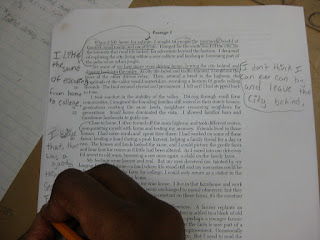
Annotating, the act of adding notes or comments to texts, whether in printed books, digital documents, or handwritten notes, is often underestimated in its ability to boost learning. It's not merely a technique for marking up your materials; it's a powerful tool that can enhance comprehension, retention, and engagement with the content. In this blog post, we'll explore how annotating can significantly increase learning outcomes and why it's a skill worth introducing in your courses. Active Engagement with Content One of the critical advantages of annotating is that it transforms passive reading or listening into active engagement. When you annotate, you're no longer a passive recipient of information but an active participant in the learning process. This increased engagement helps you process and understand the material more effectively. Focus and Concentration Annotating encourages focus and concentration. As you interact with the text, your mind is less likely to...

A Case for Writing Module Learning Outcomes

Image
Module learning outcomes are an optional, but valuable, part of course design for both educators and learners. Let’s look at what they are, and why they are important. Module learning outcomes (sometimes called objectives) are written to clarify and guide learning. They are statements of what the learner will be able to do after completing all components of instruction in the module. Module learning outcomes express the intentions of the module. They explain why the module exists—its purpose. They show learners a reason to engage with the material in that module. Module learning outcomes also relate directly to one or more of the reasons to take the course in the first place—the course competencies . Before we get any further into the value of creating module learning outcomes, let’s back up and mention where these module learning outcomes come from. When enrolling in a course, students are “promised” that the course will offer the opportunity to learn a list of things—that list is ca...

Connecting Through Video

Image
In today's digital era, online learning has taken center stage and the importance of creating appealing content for your courses cannot be overstated. Video, in particular, has emerged as the "gold standard" for online course content due to its multi-sensory nature, allowing students to both see and hear the material, making it more captivating and memorable. If you're hesitant about recording video content for your online course, fear not! You don't need expensive equipment or extensive on-camera experience to produce high-quality videos. In fact, you can do it all from the comfort of your home and even enjoy the process. By following these four steps, you'll be on your way to creating professional-looking videos that your online students will love. Step #1: Gather Your Gear When it comes to your video recording setup, having the right equipment can make a significant difference. You don't need a professional studio or pricey gear to create effective onli...

Pull Back the Curtain

Image
  Higher education often assumes that our students can figure out how the skills they learn in one context transfer to a different one. This assumption is faulty, and it’s not because our students aren’t smart enough, it’s because they aren’t content matter experts and learning experts. The same is true for us in unfamiliar areas. It isn’t clear to students that the same skill an English essay builds–written communication–will help them learn to write a clear and concise lab report in biology, or a business proposal in their future job. Think back to algebra, were you a wiz, or did you struggle trying to figure out the relevance of learning those equations? Did you know that learning algebra could help you do your job as a purchasing agent, forest ranger, or a financial advisor? Probably not. If you did, you may have paid more attention to learning algebra. One way to help students understand the relevance of an assignment is to add specific language to assignment instructions show...

Retaining Students

Image
The Completion By Design Loss/Momentum Framework helps colleges take a systems-level view and  identify where students stumble, become sidetracked, and drop out of college. One core idea of this framework is that the points where students struggle to proceed are shared by many students and are discoverable. These points are called loss points . SCC decided to apply the Loss/Momentum Framework at the course level and coach faculty in their own discovery process. This course-level view examines places in a specific course where students stop participating or drop (loss points) and places where they deeply engage (momentum points). The perfect scenario is to flip a loss point to a momentum point through interventions like better scaffolding, clearer feedback, communication about expectations, personal conversation with students, and more. We know some loss points are generic across courses--we tend to lose students at the 3-6 week time frame in a standard semester long course, or im...

Promoting Struggle

Image
Struggle is a critical component of the learning process, according to a wealth of research in the field of educational psychology. Studies have shown that students who experience cognitive struggle during learning tasks, such as solving complex problems or grappling with challenging concepts, tend to retain information better and develop more robust mental models of the material (VanLehn, Siler, Murray, Yamauchi, & Baggett, 2003). Struggling also helps students build resilience and develop a growth mindset, which can lead to improved academic and workplace performance (Dweck, 2006). Overcoming obstacles, allows us to gain a sense of accomplishment and confidence in our abilities. Our current generation of students need that confidence. “Zoomers” or “iGen” (born approximately 1995- 2012, currently 13-27 years old) are dominated by safety concerns and intimidated by risk taking. These are not students who like to “take a shot” at something and struggle. They don’t mind hard work, bu...